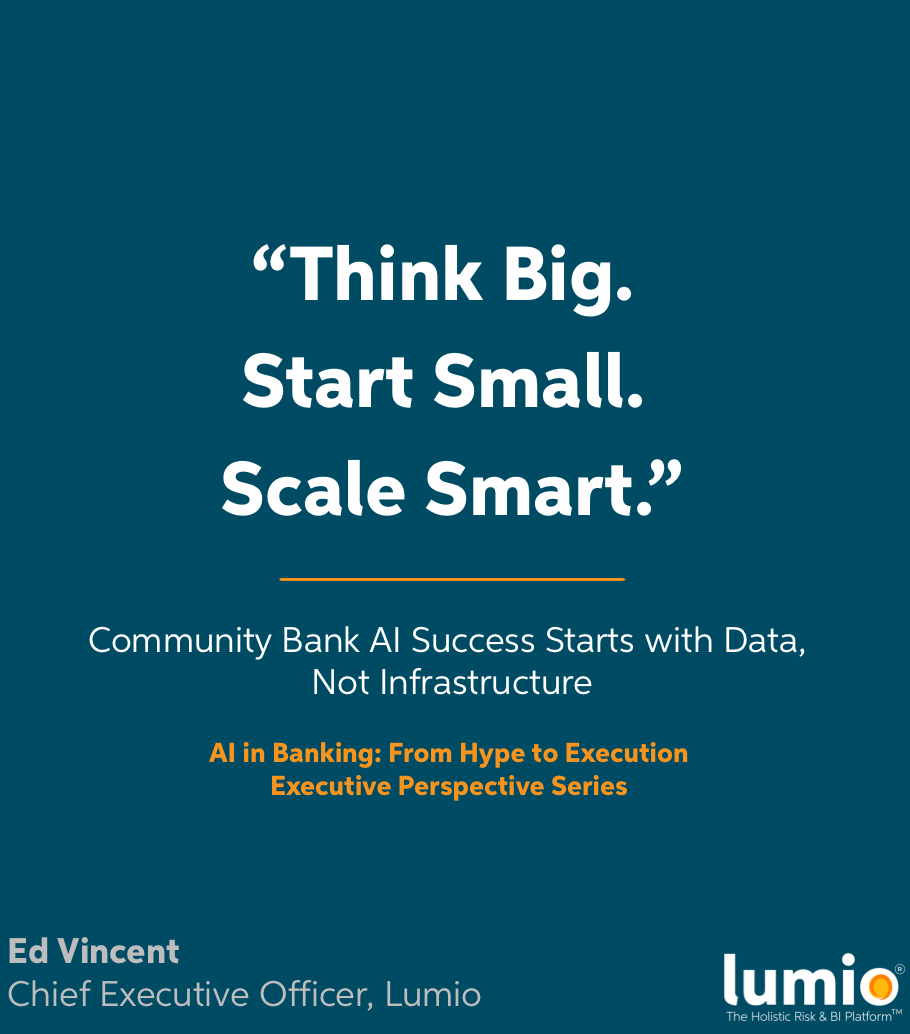
AI in Banking: Think Big. Start Small. Scale Smart.
While many community banks continue to operate with fragmented and siloed data environments, AI adoption doesn't have to wait for a massive data transformation project. By starting with a focused proof of value, centralizing a thin slice of trusted data, and applying governance, analytics, and AI tools, institutions can quickly uncover actionable insights and build a scalable foundation for operational intelligence.
Only 6% of community banks recently surveyed by Lumio described their institution’s approach to managing and accessing data for reporting, decision-making, and AI utilization, as “unified and governed, with most key data connected in a single, trusted source of truth of system of action.” Another 29% indicated the process of centralizing data is underway, with the bank “building or planning a data warehouse or data lake.”
HOW are the remaining 65%, who endure “fragmented systems, manual and siloed data, or a range of data maturity that varies by department,” expected to utilize AI in these data environments? Think Big, Start Small (with a narrow proof-of-value (POV)), and then Scale Smart.
Don’t boil the ocean…rather than attempting to aggregate all of the bank’s data, instead pull a thin slice of core or GL data into one place (a lake/warehouse), overlay basic business rules and governance, and apply calculations (aka a semantic model), render analytics and connect your favorite AI toolset. Part of the value proposition of Fiserv’s recently announced agentOS marketplace is the ability to stand up this framework quickly, easily and cost-effectively with trusted partners such as Lumio…and iterate until a bank encounters actionable insights, personalized for their institution.
GONE are the days of protracted, expensive infrastructure builds…REPLACED by personalized POVs that allow banks to unlock the power of their unique, proprietary data and the derivative insights to enable precise engagement with local customers.
What comes next for many institutions is not simply more AI experimentation. It’s operational intelligence — connecting trusted data, governance, workflows, and decision-making into systems institutions can scale with confidence. We’ll continue exploring these operational realities and implementation challenges in the weeks ahead.