AI Isn't the Only Lever: A Practical Guide for Community Banks Getting Started
A Banking on Data conversation with Dave Macolino, President & COO, Shore Group Associates
PART OF THE FUTURE OF COMMUNITY BANKING SERIES
Every community bank board is asking the same question right now: what are we doing about AI? It's the wrong question. The better one, according to Dave Macolino of Shore Group Associates, is simpler and harder: what problem are we actually trying to solve?
Dave looks at community banking from the outside in — a technology problem-solver, not a banker — and it shows in how practical his answer is. This is the third conversation in our Future of Community Banking series — following Joe Berry of KBW and Phil Goldfeder of the American Fintech Council — and the most tactical of the three.
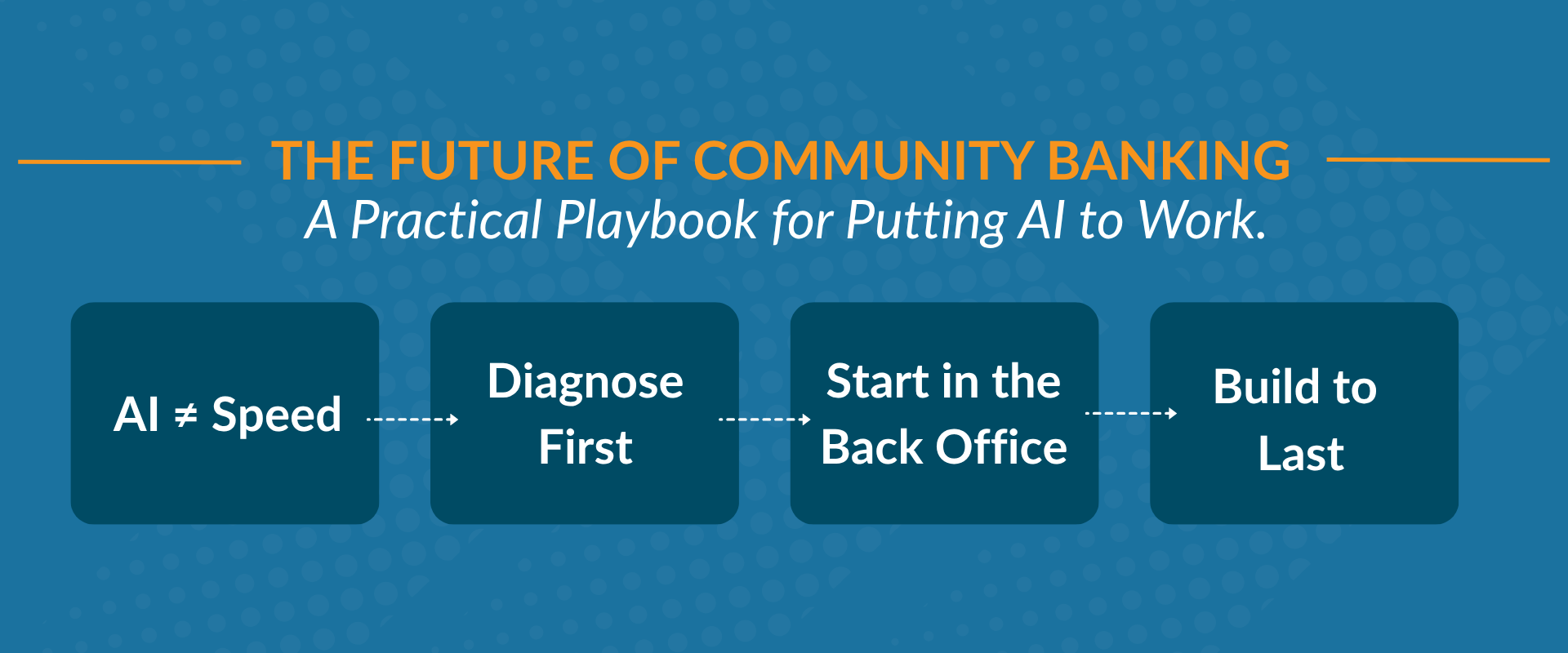
1. Speed is the goal. AI is one lever.
Community banks have moved slowly for a decade and now feel real pressure to catch up. AI is a genuine chance to flip that — but AI and speed are not the same thing. AI is one lever for velocity, not the point of the exercise and not the whole toolbox. Sometimes the right fix is a small script or a point solution, not a large language model.
2. Diagnose first — don't jump to a solution.
Hand people a license to any frontier model and you invite two failure modes: the “co-pilot paradox,” where AI tidies emails and spreadsheets but never redesigns a workflow, and “death by a thousand POCs,” where proofs-of-concept quietly run up $400–500 per person while no one can say what problem they solve. The discipline is the opposite order: define the problem, define the outcome, then choose the tool.
3. Start in the back office.
The back office is the neglected part of most banks — hundreds of spreadsheets and manual processes quietly keeping the institution running. That's exactly where the quick wins are. A useful test for where to begin: any process that eats more than an hour a week of someone's time. Pick one, solve it well, and let the first win open the door to the next.
4. Build it to last: in-house, secure, auditable.
You can use AI to build a solution without the solution itself being AI — for example, having AI help spec and write a small script or micro-app that then runs inside the bank's own environment, keeping data inside the four walls. Done with real technical judgment, that means asking the questions a novice skips (volumes, frequency, how many users, maintenance) and building in audit logging and data lineage, so every piece of data can be traced from origin to destination.
The payoff
None of this is a moonshot, and that's the point. Start with the problem, start small, keep it secure, and you build momentum without runaway costs or data risk — while strengthening the data foundation underneath everything. Which returns to the thread running through this whole series: local relationships, and the data on those relationships, are what differentiate a community bank. You can't act on that data if your house isn't in order. Getting it in order is where the future starts.
This article draws on a conversation between Ed Vincent and Dave Macolino, President & COO of Shore Group Associates, on the Banking on Data podcast. Listen to the full episode on the Lumio website and YouTube. To learn more about how Lumio helps community banks turn trusted data into confident decisions, visit lumiosolutions.io.